


You move a sofa away from the wall to hoover behind it and the smell damp hits you immediately, musty, earthy, unmistakable. You look at the wall and find dark patches, soft plaster, or visible black mould where the furniture had been sitting.
This is a common discovery in UK homes, and it is almost always more significant than it looks. The smell is not surface dust. It is the chemical signature of active mould that has been growing, undisturbed, in a poorly ventilated space, potentially for months or years. What you do in the hours and days after this discovery determines whether the problem gets properly resolved or simply reappears next winter.
What is that Smell?
The distinctive musty odour behind furniture is produced by microbial volatile organic compounds, MVOCs. These are chemical compounds released by mould and mildew colonies as metabolic waste during active growth.
MVOCs include compounds such as geosmin and 1-octen-3-ol. They are detectable by the human nose at concentrations of just a few parts per billion. The fact that you can smell them strongly means the mould colony producing them is active and established, not a surface smear that arrived last week.
The smell is typically more concentrated behind furniture than in the open room for two reasons:
- The gap between large furniture and an external wall is poorly ventilated, moisture accumulates rather than dispersing
- The back face of the furniture and the wall behind it are often the coldest surfaces in the room, making them the first to reach the dew point when warm, humid air circulates
What is Causing it
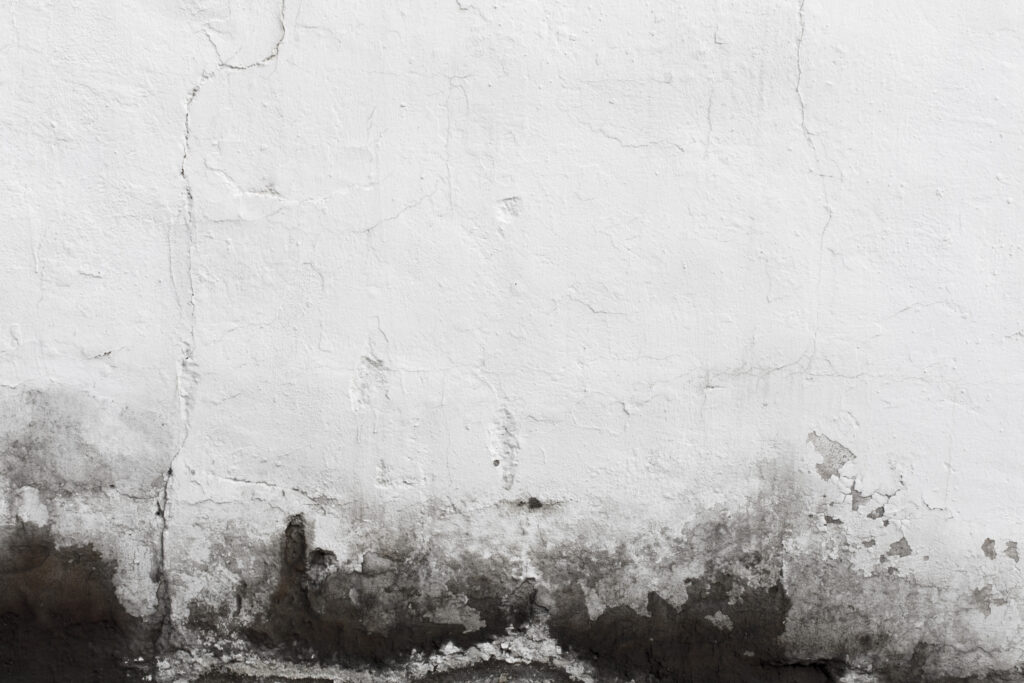
The damp smell behind furniture almost always indicates one of three moisture mechanisms. Each requires a different response.
Condensation: The Most Common Cause Warm, humid room air contacts the cold surface of an external wall hidden behind furniture. When the surface temperature drops below the dew point, moisture deposits as condensation. Repeated over weeks and months, this creates the sustained wet conditions mould needs to establish.
Signs condensation is the cause:
- The wall is an external wall on the north or east face of the building
- Mould is spread across the wall-width area rather than concentrated in a specific patch
- The problem is worse in winter and eases in summer
- Other cold spots in the same room, window reveals, ceiling corners, show similar staining
Penetrating Damp: Water Entering Through an External Defect A blocked gutter, failed pointing, cracked render, or faulty window sealant can direct water into the wall cavity directly behind where furniture sits. The furniture has been hiding the internal evidence of an ongoing leak.
Signs penetrating damp is the cause:
- The damp patch corresponds to a specific location rather than spreading evenly
- The smell and moisture are worse during or immediately after rainfall
- An external defect, a blocked downpipe, damaged render, failed flashing, is visible on the adjacent external wall
Rising Damp: Less Common, but Possible at Ground Floor Level Groundwater drawn upward through masonry can produce low-level dampness behind skirting boards and at the base of walls behind furniture.
Signs rising damp is the cause:
- Moisture is concentrated at the bottom of the wall and the skirting board area
- White salt deposits are visible at low level
- The moisture is consistent regardless of weather or season
How Serious is it?
The smell itself is your health cue as much as your structural cue. Active mould releases spores and MVOCs into the room air continuously. These cause and aggravate respiratory conditions, trigger allergic reactions, and can produce chronic fatigue with sustained exposure. Children, elderly people, and anyone with asthma or a respiratory condition are particularly vulnerable.
If the mould has been behind furniture for an extended period, which is common, since it is out of sight, the spore load in the room air may be significantly elevated even before you moved the furniture.
Do not ignore this on the basis that the mould is now exposed and the smell will fade. Without addressing the moisture source and treating the established mould colony properly, the conditions that produced it will reproduce it.
What Not to Do
Several common responses make the problem worse rather than better.
- Do not paint over the mould. Fresh emulsion over an active mould colony seals spores into the substrate and provides a brief cosmetic improvement that lasts weeks before the mould bleeds through.
- Do not clean the surface with household bleach and consider the job done. Bleach kills surface growth but does not penetrate the substrate where the spore reservoir lives. The colony re-establishes within weeks in conditions that have not changed.
- Do not move the furniture back against the wall. Restoring the cold, still, humid microenvironment behind the furniture will restart the condensation cycle immediately.
- Do not assume the problem is limited to what is visible. Mould behind furniture frequently extends into the wall substrate, behind skirting boards, and sometimes into adjacent stud cavities or insulation that the visible surface gives no indication of.
What to Do: The Correct Sequence

Step 1: Document What You Have Found. Photograph the affected area before touching it. Note the height and spread of the mould, any tide marks, any salt deposits, and any surface changes to the plaster. This is useful for any subsequent insurance claim, landlord dispute, or professional assessment.
Step 2: Identify the Probable Cause. Use the signs listed above to determine whether the most likely cause is condensation, penetrating damp, or rising damp. Check the external wall adjacent to the affected area for the condition of the guttering, pointing, render cracks, and window sealants. This does not need to be a definitive diagnosis, it is a pointer for the professional assessment that follows.
Step 3: Measure the Moisture. A calibrated pin-type moisture metre taken at multiple points across the affected wall and at increasing heights gives you an objective picture of how much moisture is present and how deep it goes. Compare readings on the affected wall to readings on an unaffected internal wall. The difference tells you the scale of the problem.
Step 4: Improve Ventilation Immediately. Move the furniture away from the wall and keep it at least 5 to 10 centimetres clear. Open windows in the affected room to begin dispersing the concentrated MVOC load. If a mechanical extract fan is present in the room or adjacent bathroom, run it.
Step 5: Commission a Professional Moisture Assessment. Surface cleaning and redecoration without a professional assessment of the moisture source is the cycle that produces the same problem returning every 6 to 12 months. A BDMA-accredited moisture survey using calibrated instruments and thermal imaging identifies the cause with precision, maps the extent of the moisture within the substrate, and recommends the correct treatment.
Step 6: Professional Mould Remediation. HEPA vacuuming of all affected surfaces before any wet treatment, not after. Professional-grade biocidal treatment at the correct concentration and dwell time. HEPA air scrubbing during and after treatment to capture elevated airborne spores. Post-remediation moisture readings to confirm the substrate is returning to the dry standard.
Step 7: Address the Source. Condensation requires ventilation improvement, mechanical extract, trickle vents, positive input ventilation. Penetrating damp requires identification and repair of the external defect. Rising damp requires professional assessment of the damp-proof course. No treatment of the mould itself produces a lasting result if the moisture mechanism driving it continues.
Disaster Care Capital provides BDMA-certified mould assessments and professional remediation across London. We identify the cause, treat the established mould to the correct professional standard, produce the written documentation that satisfies Awaab’s Law and insurance requirements, and advise on the source resolution. Call us today for a free same-day assessment.
Conclusion
A damp smell discovered behind furniture is an active mould problem that has been developing out of sight. The smell indicates a live colony, not a stale one. Surface cleaning and repainting produces temporary improvement. Identifying the moisture source, professionally treating the established mould, and addressing the ventilation or structural defect driving it produces a lasting one. The correct sequence starts with documentation and moisture assessment, not a tin of paint.
Frequently Asked Questions
Why Does it Smell Damp Behind Furniture?
The smell is microbial volatile organic compounds produced by active mould growth in the poorly ventilated, cold space between furniture and an external wall. Warm, humid room air repeatedly condenses on the cold wall surface, providing sustained moisture for mould colonies to establish and grow undisturbed.
Is Mould Behind Furniture Dangerous?
Yes, active mould releases spores and chemical compounds into the room air continuously, which can cause and worsen respiratory conditions, trigger allergic reactions, and produce chronic symptoms with prolonged exposure. Children, the elderly, and those with existing respiratory conditions are most vulnerable.
Can I Clean Damp Mould Behind Furniture Myself?
Surface cleaning with household products removes visible growth but does not eliminate the spore reservoir within the substrate, and the mould re-establishes quickly in conditions that have not changed. Professional-grade biocidal treatment with HEPA vacuuming before any wet treatment, combined with source resolution, is what produces a lasting result.
Should I Call a Professional if I Find Mould Behind Furniture?
If moisture metre readings are significantly elevated within the wall substrate, if the mould covers a large area, if previous surface treatment has produced temporary improvement followed by recurrence, or if the property is rented and an objective cause assessment is needed, then yes, a BDMA-certified professional assessment is the right response.





