


The visible damage from a house fire is obvious and immediate. The smoke odour that remains after the flames are out is often underestimated, and it is frequently what makes a property uninhabitable long after the structural work is complete.
Smoke odour after a fire does not simply fade over time. It penetrates porous building materials at a molecular level and continues producing odour compounds for months or even years if not properly treated. A property where the walls have been replastered, the ceiling repainted, and the flooring replaced can still smell strongly of smoke if the underlying treatment was inadequate, because the smell source is not on the surface but within the substrate.
Understanding why smoke odour behaves the way it does is the essential first step toward treating it correctly.
Read also: how to get smoke odour out of furniture
Why Smoke Odour is So Persistent
The persistence of smoke odour is not a mystery. It has a specific chemistry.
When a fire burns, combustion produces microscopic particles, many of them smaller than one micron in diameter. These particles carry complex organic compounds called polycyclic aromatic hydrocarbons (PAHs), aldehydes, and other volatile organic compounds (VOCs) that are the chemical source of the smoke odour. Because the particles are so small, they penetrate porous materials at depth. Materials like plasterboard, timber, plaster, insulation, fabric, carpets, and even the surface coatings of hard materials absorb these compounds.
The odour you detect is the ongoing off-gassing of these compounds from the porous materials they have penetrated. Warmth accelerates this off-gassing, which is why a smoke-damaged property smells worse in summer, after the heating comes on, and in enclosed rooms, making the odour intensify rather than fade after what seemed like adequate treatment.
Surface cleaning removes contamination from the visible surface. It does not reach the compounds absorbed within the substrate. This is the fundamental reason why painting over smoke-damaged walls, or simply wiping down surfaces and ventilating, does not eliminate the odour, it only masks it temporarily.
The Materials That Hold Smoke Odour Longest
Not all materials absorb and retain smoke compounds equally. Understanding which materials are the primary odour sources in a fire-damaged property helps prioritise treatment.
The worst offenders are:
- Soft furnishings and fabrics: upholstered furniture, curtains, carpets, and rugs absorb smoke compounds deeply and off-gas continuously. Any porous fabric material that was in the property during the fire and has not been professionally cleaned or replaced is likely a primary odour source.
- Insulation within walls and ceilings: mineral wool, glass fibre, and foam insulation materials absorb smoke at high rates and are inaccessible to surface treatments. They continue off-gassing through the finished wall or ceiling surface.
- Timber components: structural timber, floor joists, skirting boards, door frames, and subfloors absorb smoke compounds and hold them for extended periods. Timber that has been charred or heated without burning still carries significant contamination.
- Plasterboard: whose paper facing and gypsum core absorb smoke compounds, is particularly vulnerable on the back face that sits against the wall cavity.
- Ductwork and ventilation systems: one of the most commonly missed odour sources in a fire-damaged property. The HVAC system, any mechanical ventilation, and all ductwork distributes smoke throughout the property during a fire event and retains particles within the duct surfaces. Without professional duct cleaning, the system continues circulating smoke odour through the property every time it runs.
READ ALSO- Fire damage to a listed building UK, what are the rules?
Why Surface Cleaning is Not Enough
The most common error in treating post-fire smoke odour is treating it as a cleaning problem rather than a penetration problem.
Standard cleaning products, even professional-grade cleaning agents applied to surfaces, work at the surface level. Smoke contamination in plasterboard, timber, and plaster is not at the surface level. It is throughout the substrate. A wall that tests clean for surface contamination can still produce strong smoke odour because the compounds within the material continue off-gassing outward.
Painting over smoke-damaged walls accelerates this failure pattern. Applying paint seals the surface but does not prevent off-gassing from within the material, the compounds migrate through the paint film over weeks and months, producing staining, bleed-through, and persistent smell. A property where smoke-damaged walls were painted without specialist substrate sealing almost always develops this problem within the first year.
Professional Smoke Odour Removal: What Actually Works
The correct treatment for post-fire smoke odour uses a sequence of methods, each targeting the contamination at different depths.
HEPA Vacuuming First
Before any wet treatment, all surfaces, walls, ceilings, floors, and every horizontal surface, must be thoroughly HEPA-vacuumed to remove loose smoke particles. Wet cleaning a surface before vacuuming drives particles deeper into the substrate. HEPA filtration is required because standard vacuum filters do not capture particles below one micron, the particle size responsible for most smoke contamination.
Chemical Sponge Dry Cleaning
Chemical sponge cleaning, using a vulcanised rubber sponge that lifts rather than spreads smoke particles, is the correct first-pass cleaning method for walls, ceilings, and other surfaces. It removes surface contamination without adding moisture and without abrading the surface.
Substrate Sealing Before Redecoration
Any wall, ceiling, or timber surface that has been exposed to smoke must be treated with a specialist smoke-blocking sealer before any decoration is applied. These are shellac or water-based blocking primers designed to encapsulate the smoke compounds within the substrate and prevent them from migrating through the finish coat. Without this step, repainting simply delays rather than prevents odour and staining reappearance.
Thermal Fogging
Thermal fogging uses a heated machine to generate a fine solvent-based fog that penetrates porous surfaces to the same depth that smoke particles have reached. The fogging agent reacts with and neutralises odour compounds within the material, not just masking them but chemically altering the compounds responsible for the smell. The fog reaches inside wall cavities, into porous materials, and into spaces where spray application cannot penetrate.
Thermal fogging is the most effective single treatment for established smoke odour within building fabric and is the method used by professional restoration companies on significant fire damage events.
Ozone Treatment
Ozone generators produce O₃ molecules that oxidise and break down organic odour compounds, including smoke VOCs. Ozone treatment at the concentrations required for fire odour elimination is not safe for occupation during treatment, the property must be vacated and the generator operated under controlled conditions by a qualified operator. Following treatment, the ozone dissipates and the property is safe to re-enter.
Ozone treatment is effective for treating residual odour after the primary smoke contamination has been addressed through cleaning and fogging. It reaches areas that physical treatment cannot, inside ventilation ducts, within the building fabric, and in enclosed spaces.
HEPA Air Scrubbing
Industrial HEPA air scrubbers run throughout the treatment programme, capturing airborne smoke particles and reducing the ambient particle count. This protects the health of anyone in the building during works and reduces the re-deposition of particles onto surfaces being treated.
For guidance on fire damage insurance claims and your rights, check: ABI, home insurance fire damage claims
When Hidden Smoke Damage Indicates Structural Problems
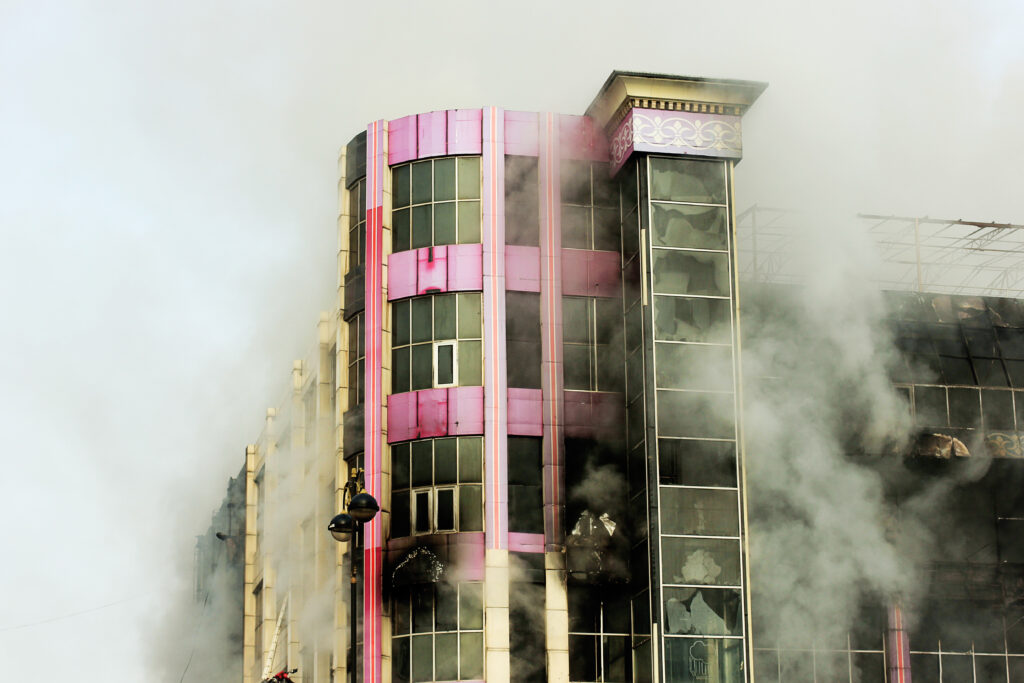
Post-fire smoke odour that persists despite professional surface treatment sometimes indicates that smoke contamination exists in areas that surface treatment cannot access. The most common sources are:
- Smoke penetration into wall cavities, if smoke entered the cavity between the inner and outer leaf of a cavity wall, or between plasterboard and the structural wall behind it, surface treatment reaches only the finished face
- Contaminated insulation, insulation within walls and ceilings that absorbed smoke cannot be treated in place; it requires removal and replacement
- Charred or contaminated sub-floor structure, in properties where smoke penetrated beneath floorboards, the joists, noggins, and subfloor void require direct treatment
Where persistent odour following professional treatment suggests these deeper contamination sources, a thermal imaging survey and assessment of cavity and sub-floor conditions is the appropriate next step.
Disaster Care Capital provides BDMA-certified fire and smoke damage restoration across London, including thermal fogging, ozone treatment, HEPA air scrubbing, and the full substrate treatment sequence that eliminates smoke odour rather than masking it. Call us today for a free same-day assessment.
For IICRC S700 standard for professional smoke and fire restoration, check: IICRC, fire and smoke restoration standard
Conclusion
Smoke odour after a fire persists because smoke compounds penetrate porous materials at depth, not because the property has not been cleaned thoroughly enough. Surface cleaning, ventilation, and repainting without specialist substrate treatment does not eliminate the odour; it delays its reappearance. The correct sequence — HEPA vacuuming, chemical sponge cleaning, substrate sealing, thermal fogging, ozone treatment, and HEPA air scrubbing — addresses contamination at every depth and is the only approach that produces a lasting result.
Disaster Care Capital delivers this full treatment sequence for fire-damaged properties across London, with BDMA-certified technicians and full insurer documentation from first assessment to completion.
Frequently Asked Questions
Is the smell of smoke in a house dangerous?
Yes. Smoke residues contain polycyclic aromatic hydrocarbons (PAHs), VOCs, and fine particles that pose respiratory and health risks, particularly with prolonged exposure. Properties with persistent smoke contamination should not be occupied without professional assessment and remediation, particularly for children, elderly residents, and anyone with respiratory conditions.
Does insurance cover smoke odour removal after a fire?
Yes, most standard home insurance policies cover fire and smoke damage remediation as part of the reinstatement of the property. Smoke odour treatment, including thermal fogging and ozone treatment, is a recognised and insured element of the restoration scope. Notify your insurer immediately after any fire event and request that the full smoke remediation programme is included in the agreed scope of works.
Will the smoke odour go away on its own after a fire?
No, smoke odour does not simply fade over time. The compounds responsible are embedded within the building fabric and will continue off-gassing indefinitely, often seeming to worsen in warm weather or when heating is used. Professional treatment is required to address contamination at the depth it has reached.





