


You have a damp patch. You can see it, you can smell it, and it is getting worse. The instinct is to apply a surface sealant, repaint over it, or call someone to spray it with biocide. But none of those responses will work if they are treating the wrong type of damp. And the most common types of structural damp look similar on the surface, have entirely different causes, and require entirely different solutions.
Misidentifying damp is one of the most expensive mistakes a homeowner or landlord can make. Paying for rising damp treatment when you have penetrating damp will leave the moisture source intact, the treatment will fail, and the problem will return. Treating penetrating damp when the cause is actually rising damp produces the same result. Getting the diagnosis right before spending any money is not optional — it is the only approach that makes financial sense.
1. Why the Distinction Matters Before You Spend Any Money
Damp treatment in the UK is a significant market, and it is one with a track record of overselling. Rising damp treatments in particular have historically been applied to properties where the cause of damp was something else entirely, wasting thousands of pounds and leaving the real problem unresolved.
The practical consequences of misdiagnosis are:
- Wasted treatment cost — the wrong treatment, however well executed, cannot address a moisture source it was never designed for
- Continued structural damage — damp left in building materials causes mould establishment, timber decay, plaster failure, and masonry erosion. Every week of continued moisture exposure adds to the remediation cost
- Reinstatement failure — decorating, plastering, or flooring over untreated damp produces results that fail within weeks to months as moisture pushes through the new surface
The correct order of operations is: identify the type of damp first, address the cause second, treat the affected materials third, and only then reinstate the decoration. Doing these in any other order is expensive and futile.
2. What Rising Damp Is — and What Causes It
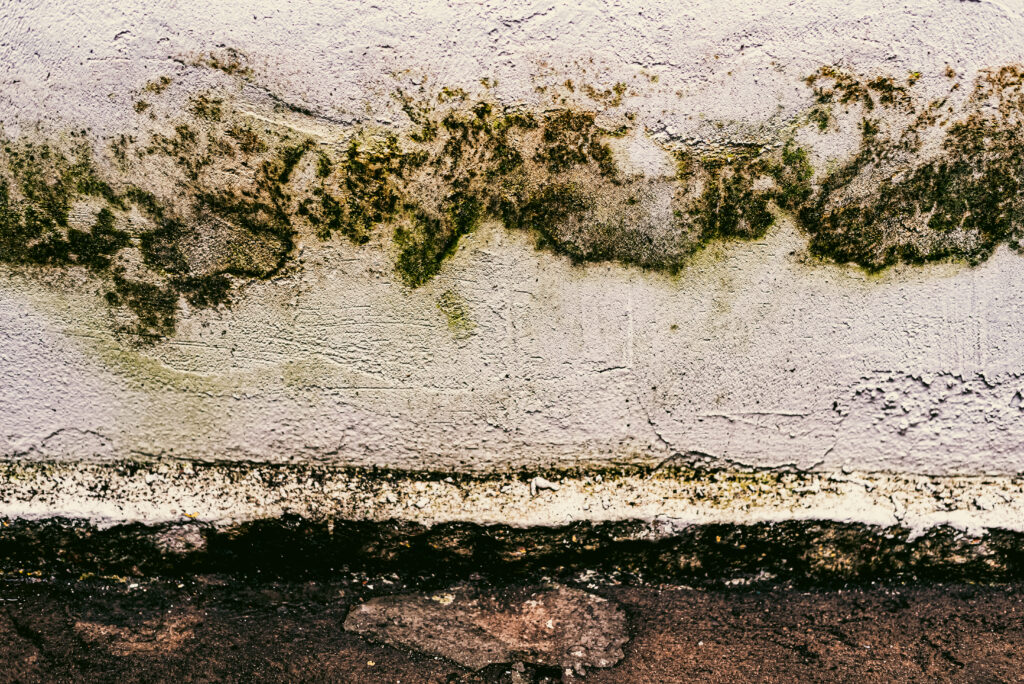
Rising damp is groundwater being drawn upward through the masonry of a building by capillary action. It is a physical process in which water moves through the microscopic pores in brick, stone, and mortar driven by the differential between moisture content in the ground and moisture content in the wall above.
What causes rising damp:
- A failed or absent damp-proof course (DPC) — the physical or chemical barrier built into the wall at low level to prevent groundwater rising. In Victorian and Edwardian properties, the original DPC was typically a layer of slate or engineering brick. When this fails, cracks, or was never installed, groundwater rises freely.
- A bridged damp-proof course — even a functioning DPC can be bypassed if external ground levels have risen above it (through landscaping, paving, or soil accumulation), if render has been applied across it, or if a pathway is built against the house wall above DPC level
- No DPC at all — many pre-Victorian properties in London were built without any DPC provision; rising damp in these buildings is essentially structural
Visual characteristics of rising damp:
Rising damp has a distinctive profile that reflects its mechanism:
- A horizontal tide mark on the lower section of the wall, typically between 0.5 and 1 metre above floor level — this represents the height to which capillary action can raise groundwater in the specific masonry
- White salt deposits (efflorescence) on the wall surface, sometimes powdery, sometimes crystalline — these are hygroscopic salts drawn from the ground and deposited as the water evaporates at the surface
- Damage and deterioration concentrated at the base of walls — lifting skirting boards, damaged plaster at low level, rotting timber where floor joists meet saturated masonry
- The problem is typically worse in winter and during prolonged wet periods
- It does not appear above first floor level — capillary action has a physical height limit
3. What Penetrating Damp Is — and What Causes It
Penetrating damp is water entering the building horizontally through the external fabric — through walls, roofs, windows, or any structural element that has failed to keep external water out. Unlike rising damp, it is not driven by groundwater — it is driven by weather and by the condition of the building envelope.
What causes penetrating damp:
- Failed pointing or render — mortar joints that have cracked, eroded, or been damaged allow wind-driven rain to penetrate the masonry. This is the most common cause in older London properties with solid brick construction.
- Blocked or damaged guttering and downpipes — when guttering overflows or a downpipe leaks, sustained volumes of water saturate the wall directly beneath. The classic “wet patch appearing in heavy rain and drying out afterwards” is almost always a guttering or drainage problem.
- Failed roof flashings — lead or mortar flashings around chimney stacks, parapet walls, and roof abutments fail over time, allowing water to track down into the wall beneath.
- Cracked or damaged render — solid render on external walls can develop hairline cracks that are invisible from street level but allow capillary ingress of rainwater.
- Poorly sealed windows and doors — frame-to-wall joints that have failed allow water to track behind the frame and into the internal wall.
- Flat roof failures — water ponding on a flat roof with damaged membrane will eventually find its way through the roof deck into the structure below.
Visual characteristics of penetrating damp:
The pattern of penetrating damp is shaped by where the defect is and where water flows after entering the building:
- Damp patches that appear during or after heavy rain and partially or fully dry out in dry weather — this correlation with weather events is the strongest diagnostic indicator
- Patches that appear at various heights on the wall — not concentrated at low level, and potentially appearing at ceiling level or upper floors
- A more irregular and localised distribution than rising damp — the patch tends to reflect the specific failure point
- In the case of guttering problems, a vertical strip of damp appearing in the same location as a downpipe or gutter joint above
- No salt deposits in most cases — the water is rainwater, not groundwater, and carries fewer mineral salts
4. Key Visual Differences Between the Two
The table below summarises the most useful diagnostic characteristics for distinguishing rising damp from penetrating damp on visual inspection alone:
| Feature | Rising damp | Penetrating damp |
| Location on wall | Low level — base of wall | Any height — depends on defect location |
| Shape of damp patch | Horizontal tide mark, broadly even height | Irregular, localised, follows water path |
| Salt deposits | Usually present — white powdery efflorescence | Rarely present |
| Correlation with weather | Not directly correlated with rainfall | Typically worse during or after rain |
| Drying behaviour | Does not fully dry out in dry spells | May partially or fully dry in dry weather |
| Floor level affected | Ground floor and lower walls | Any floor depending on defect |
| Timber damage | Typically at low level — skirtings, joist ends | Depends on location |
| External cause | Failed or absent DPC | Defect in building envelope |
Neither of these patterns is perfectly consistent in every property. Older buildings, poorly maintained properties, and buildings where previous patchy repair work has been done may present mixed signals. This is one of the primary reasons why visual inspection alone is unreliable for definitive diagnosis.
5. Other Types of Damp: Condensation Damp
Before investing in treatment for either rising or penetrating damp, condensation must be ruled out — because condensation is the most common cause of mould and damp symptoms in UK homes, and it is frequently misidentified as structural damp.
Condensation damp occurs when warm, humid indoor air meets cold surfaces — typically external walls, window reveals, and cold bridge areas at the junctions of walls and ceilings. The water vapour in the air deposits as liquid on the cold surface. In persistently cold periods without adequate ventilation, this moisture accumulates and becomes a substrate for mould growth.
Condensation indicators that distinguish it from rising and penetrating damp:
- Mould appearing in corners, around window frames, and on ceiling edges — the coldest points in the room
- Damp or mould concentrated on north-facing walls in poorly heated rooms
- Window condensation visible on a regular basis — a clear sign the indoor humidity is too high relative to surface temperatures
- Problems that are worse in winter and better in summer — condensation is seasonal in a way that structural damp is not always
- Problems that correlate with occupancy patterns — worse in rooms that are used frequently, better in rooms that are well ventilated
Condensation mould can be addressed through improved ventilation, heating, and in persistent cases, mechanical ventilation with heat recovery (MVHR). It does not require a DPC injection or external envelope repair. Treating condensation as rising or penetrating damp is another common and expensive misidentification.
Read also-Leak locating equipment
6. Why a Professional Moisture Survey Is the Only Reliable Diagnosis
Visual inspection, however experienced, has limits. The surface expression of damp is frequently misleading. Rising damp in a wall with a failed DPC can produce patches that look identical to penetrating damp from a failed flashing above. Condensation in a poorly heated room can produce mould patterns that suggest rising damp to an inexperienced eye.
The only way to diagnose damp definitively is with professional moisture assessment combining:
- Calibrated moisture metres — both pin-type (measuring moisture content within building materials) and survey metres (mapping moisture distribution across wall surfaces without surface contact). These readings distinguish surface moisture from deep material saturation and identify moisture gradients within the wall.
- Thermal imaging cameras — identifying temperature differentials in walls and ceilings caused by moisture presence. Thermal imaging maps the distribution and extent of moisture problems invisible to the naked eye, including moisture behind plaster, within wall cavities, and beneath floor coverings.
- Salt analysis — identifying the specific mineral salts present in the damp patches. Rising damp produces characteristic hygroscopic salts (primarily nitrates and chlorides) drawn from the ground. Penetrating damp typically shows fewer salts and a different distribution.
- External inspection — assessing the building envelope for the specific defects likely to be producing the pattern of moisture observed internally.
Together, these tools produce a moisture survey report that identifies the type of damp, the probable cause, the extent of affected materials, and the remediation required. This report is the basis for treatment decisions, contractor specifications, and — where applicable — insurance claim documentation.
Disaster Care Capital provides professional moisture surveys across London using thermal imaging cameras and moisture mapping. Get a definitive answer rather than an expensive guess. Call us today for a fast assessment.
For further reading on damp and building fabric health, check: RICS — damp and building defects guidance
7. What Happens If Damp Is Left Untreated
Both rising and penetrating damp are progressive. Left unaddressed, the consequences compound over time:
Mould establishment — moisture in building materials creates the conditions for mould germination within 24 to 48 hours. Mould within walls, under plaster, and behind skirting boards releases spores into the living environment, with respiratory and allergenic health consequences particularly for children, the elderly, and anyone with asthma or compromised immunity.
Timber decay — timber that remains above 20% moisture content for a sustained period becomes susceptible to wet rot. Floor joists, skirting boards, window frames, and structural timbers embedded in damp masonry are all at risk. Wet rot that is left to progress sufficiently can require structural timber replacement, a significantly more expensive intervention than the damp treatment that would have prevented it.
Plaster and masonry damage — hygroscopic salts drawn into plaster by rising damp are hygroscopic in themselves and they absorb moisture from the air even in relatively dry conditions, causing persistent dampness in the plaster surface that cannot be resolved by decoration alone. Freeze-thaw cycling in masonry that has absorbed water causes progressive spalling and structural erosion.
Declining property value and sale complications — damp problems identified in a homebuyer’s survey are among the most common reasons for price renegotiation, delayed completions, and mortgage refusals. Evidence of untreated long-term damp is a significant red flag for buyers and their surveyors.
For GOV.UK guidance on damp and mould in residential properties, check: GOV.UK — damp and mould health risks
Conclusion
Rising damp and penetrating damp have different causes, different patterns, and different solutions. Treating the wrong type of damp wastes money and leaves the real problem intact. And both can be misidentified as condensation, further complicating a treatment decision that has significant financial consequences if it goes wrong.
The only reliable way to distinguish between them is professional moisture assessment using calibrated instruments, thermal imaging, and an external building inspection. The visual clues in this guide narrow down the possibilities, but they are not a substitute for a properly conducted moisture survey. Disaster Care Capital provides definitive diagnosis, not an expensive guess, backed by the documentation your insurer, your solicitor, and your contractor will require.
Frequently Asked Questions
Can rising damp cause mould?
Yes — rising damp saturates the base of walls and can maintain elevated moisture content in plaster and masonry for extended periods. Where humidity at the material surface is consistently high enough, mould establishes on the plaster surface and within the wall fabric. The mould is a symptom of the ongoing moisture; treating it without addressing the rising damp will produce the same mould again within weeks.
How do I know if I have damp or just condensation?
Look for the pattern: condensation typically affects corners, window reveals, and ceiling edges and correlates with occupancy and weather. Structural damp (rising or penetrating) tends to produce more persistent patches, often with salt deposits, that do not fully dry out in warmer periods. A hygrometer measuring consistently high indoor humidity alongside cold surfaces confirms condensation conditions.
What does a damp survey involve?
A professional damp survey uses calibrated moisture metres to measure material moisture content at defined points in the affected walls, thermal imaging to map moisture distribution, salt analysis of the affected plaster, and external inspection of the building envelope. The survey produces a written report identifying the damp type, probable cause, extent of affected materials, and the recommended remediation.





