


Mould in a rented property is not just a cosmetic problem. It is a health hazard, a legal liability and, since October 2025, a potential statutory compliance failure.
For landlords, the question of how to prevent mould in a rented property has become more urgent than ever. For tenants watching black patches reappear on the same bathroom ceiling month after month, the frustration is real and the health risk is genuine.
This guide covers both sides of the problem: what the law now requires, what causes mould to keep returning, and what practical steps actually make the difference.
At Disaster Care Capital, we provide Awaab-compliant mould remediation for landlords and property managers across London, with written reports documenting cause, treatment, and steps taken.
What Awaab’s Law Means for Landlords in 2025
Awaab’s Law, formally the Hazards in Social Housing (Prescribed Requirements) (England) Regulations 2025, came into force on 27 October 2025 for social housing landlords in England.
It is named after two-year-old Awaab Ishak, who died from a severe respiratory infection caused by prolonged exposure to mould in his Rochdale home. His family had reported the problem repeatedly to their landlord for three years. No action was taken.
The timescales Awaab’s Law imposes on social landlords:
- Investigate any reported significant damp and mould hazard within 10 working days
- Provide tenants with written findings within 3 working days of the investigation concluding
- Begin relevant safety works within 5 working days of investigation completion
- For emergency hazards: investigate and make safe within 24 hours
Awaab’s Law currently applies to social housing. However, the government has confirmed its intention to extend it to the private rented sector, and private landlords already have overlapping duties under the Homes (Fitness for Human Habitation) Act 2018, the Landlord and Tenant Act 1985, and the Housing Health and Safety Rating System.
The practical message for private landlords is this: the Housing Ombudsman has stated explicitly that landlords cannot automatically blame mould on tenant “lifestyle choices.” If the property lacks adequate ventilation, insulation, or heating — the mould is the landlord’s responsibility.
Documenting your prevention efforts, reporting responses, and any professional treatment carried out is essential protection against disrepair claims, housing ombudsman complaints, and future enforcement.
Why Mould Keeps Coming Back Even After Cleaning
This is the question tenants ask most often, and the answer is almost always the same.
Surface cleaning removes the visible colony. It does not remove the conditions that created it.
Mould needs three things: moisture, a surface, and a temperature above about 5°C. Cleaning the mould removes the surface growth. But the moisture source is still present. Within weeks, the same spores that survived in the wall, in the grout, or in the building fabric germinate again.
There is also a hidden dimension. The visible patch of black mould on a bathroom ceiling is often the surface expression of a larger colony inside the wall cavity, within ceiling voids, or behind plasterboard. Cleaning the surface without addressing what is inside achieves nothing lasting.
The only way to permanently eliminate mould in a rented property is:
- Identify and remove the moisture source
- Professionally remediate the existing colony, including hidden growth
- Reduce indoor humidity to levels that prevent re-establishment (ideally below 60% relative humidity)
If that sequence is not followed, mould will return. Without exception.
The Difference Between Condensation Mould and Structural Damp
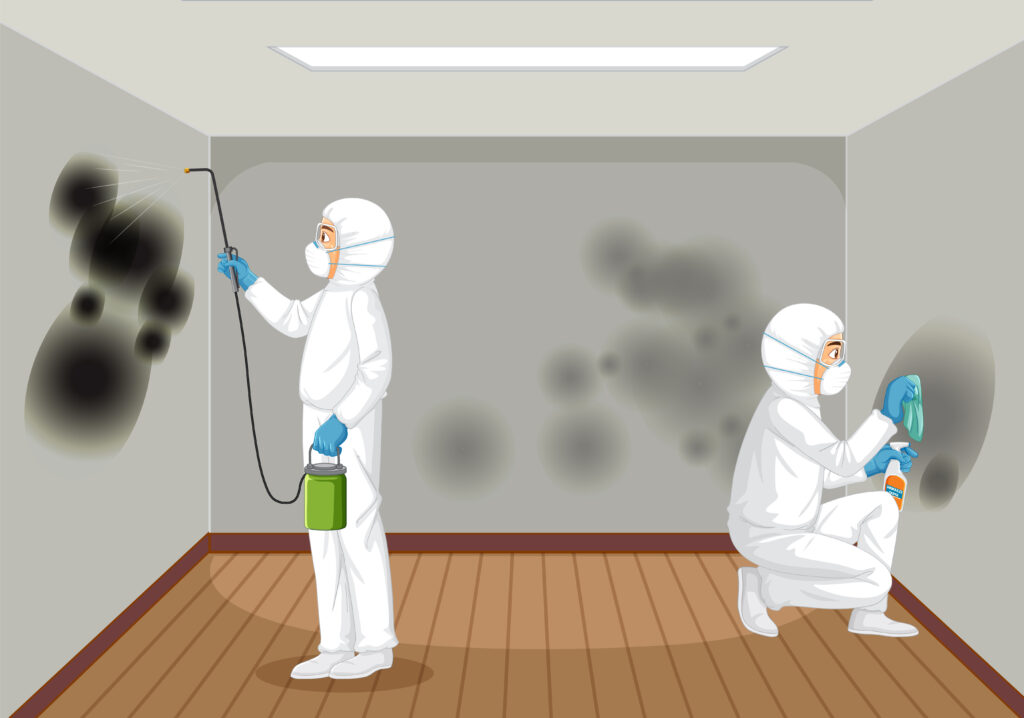
This distinction matters because the treatment and the legal responsibility are different.
Condensation mould is the most common type in UK rental properties. It forms when warm, moisture-laden indoor air meets cold surfaces, typically exterior walls, window reveals, and poorly ventilated corners. It appears as black speckling, often in the same locations repeatedly: bathroom ceilings, bedroom corners, behind wardrobes.
Condensation is produced by everyday activities: cooking, bathing, breathing, and drying clothes indoors. A typical five-person household produces up to 10 litres of water vapour per day from these activities alone.
Condensation mould is not solely a tenant behaviour problem. The Housing Ombudsman’s updated guidance makes clear that if the property’s ventilation, heating, or insulation cannot cope with normal occupancy, the building is deficient, and that is the landlord’s responsibility.
Structural damp arises from water entering the building from outside or rising from the ground. Signs include:
- Damp patches that worsen after rain or in wet weather
- Tide marks and salt deposits on walls
- Damage at the base of walls consistent with rising damp
- Patches that appear regardless of tenant behaviour
Structural damp is unambiguously the landlord’s responsibility. It requires repair of the building defect, not just surface treatment.
Why the distinction matters for prevention: condensation mould can often be prevented with ventilation and heating improvements. Structural damp requires building repairs, and the right approach depends on correctly diagnosing which you are dealing with.
Ventilation: the Single Biggest Preventable Cause
Poor ventilation is the primary driver of condensation mould in UK rented properties. It is also the most addressable.
When moisture-laden air cannot escape a building, it settles on cold surfaces and mould follows. Sealed double glazing, draught-proofing, and modern construction that prioritises energy efficiency over air exchange all reduce natural ventilation, often inadvertently creating conditions for mould.
What landlords should ensure is in place:
- Working extractor fans in kitchens and bathrooms — ideally humidity-controlled units that activate automatically when moisture levels rise
- Fans with an over-run function — so extraction continues for a period after the light is switched off
- Trickle vents in windows that are unobstructed and functional
- Airbricks at floor level in older properties, kept clear of debris
- Cooker hoods vented to the outside (not re-circulating)
- Under-floor ventilation in suspended floor properties
Government guidance from the Ministry of Housing explicitly states that landlords should install humidity-controlled fans where condensation is a known issue — and that replacing or repairing ventilation systems is a legal obligation where deficiency is contributing to a damp and mould hazard.
What tenants should do:
- Open windows briefly during and after cooking, showering, and bathing — even in winter; short bursts of ventilation lose less heat than letting moisture build up
- Use extractor fans every time, and leave them running after use
- Keep bathroom and kitchen doors closed when generating steam
- Move furniture a few inches from exterior walls to allow air circulation
- Avoid drying clothes on radiators without opening a window
Read also- why does mould grow on walls
Heating and Humidity — the 18°C Rule
Cold properties are damp properties. Cold air holds less moisture than warm air — so when a property is poorly heated, the moisture that would otherwise remain suspended in air settles on walls and produces condensation.
British Standards and council guidance both specify the same heating targets:
- Living rooms and dining rooms: 21°C when the outside temperature is -1°C
- Bedrooms and other rooms: 18°C when the outside temperature is -1°C
- Bathrooms: 22°C
This is the landlord’s responsibility at the building level — the heating system must be capable of reaching these temperatures. It is the tenant’s responsibility day-to-day to use it.
The low background heat principle: a consistent low heat throughout the day is more effective at preventing condensation than intermittent high-heat bursts. Rapid temperature drops cause moisture to precipitate out of the air and settle on walls.
For landlords, this means:
- Ensuring the boiler and heating system are in full working order and adequately sized for the property
- Checking that radiators reach all key areas, including bedrooms
- Considering insulation improvements — loft, cavity wall, and floor insulation all reduce cold spots that attract condensation
- Where cost-of-living pressures mean tenants struggle to heat the property, signposting to Warm Home Discount and local fuel poverty support
Target indoor relative humidity for mould prevention is below 60%. Above this level, mould establishment becomes progressively more likely. A hygrometer (humidity meter) costs under £15 and is a simple tool for both landlords and tenants to monitor conditions.
Read also- how to stop mould in bedroom
What Tenants Can Do vs What Requires a Landlord to Act
Responsibility for preventing mould in a rented property is genuinely shared — but the split is clearer than most disputes suggest.
Tenants are responsible for:
- Ventilating during and after moisture-generating activities
- Reporting any mould or damp in writing, promptly, as soon as it appears
- Keeping the property adequately heated to the levels the heating system can achieve
- Wiping down condensation from windows and cold surfaces before mould develops
- Not blocking trickle vents, extractor fans, or airbricks
- Allowing access for inspections and repairs
Landlords are responsible for:
- Providing a working, adequate heating system capable of reaching the required temperatures
- Installing and maintaining extractor fans in kitchens and bathrooms
- Repairing structural defects causing penetrating or rising damp
- Responding to mould reports within the timescales required by law
- Investigating whether mould is caused by a building deficiency rather than defaulting to “tenant behaviour”
- Carrying out professional remediation where surface cleaning has failed
The key rule: if mould returns to the same location despite the tenant following ventilation and heating guidance, this indicates a structural or systemic cause — and that is the landlord’s problem, not the tenant’s.
For more information on landlord obligations and mould, check: GOV.UK — understanding and addressing damp and mould
When DIY Prevention Is Not Enough — Signs You Need a Professiona
Surface cleaning with household mould spray handles small, isolated patches caused by temporary condensation. It does not handle the following:
- Recurring mould at the same location — the source is structural or the colony extends beyond the surface
- Mould covering large areas — typically more than one metre square — which requires professional containment and remediation to prevent spore dispersal during removal
- Black mould (Stachybotrys chartarum) — a species associated with mycotoxin production; remediation requires specialist equipment including HEPA air scrubbers and protective protocols
- Mould inside wall cavities, behind plasterboard, or beneath flooring — surface treatment cannot reach these colonies; they require professional assessment and, in many cases, controlled strip-out and remediation
- Mould in the context of Awaab’s Law compliance — social landlords need documented, professional evidence of investigation, treatment, and steps taken to prevent recurrence
The failure mode of DIY treatment: the mould colony is disturbed, releasing spores into room air, increasing airborne concentrations temporarily. Without the correct protective equipment and air scrubbing, this makes indoor air quality worse in the short term and does not eliminate the colony from within building materials.
A professional mould remediation programme includes:
- Full assessment of moisture source and extent — including within cavities and structural elements using moisture meters and thermal imaging
- HEPA vacuuming of affected surfaces to safely capture spores
- Antifungal treatment of all affected materials
- Air scrubbing to reduce airborne spore concentrations
- Post-remediation air quality testing and written completion report
Disaster Care Capital provides Awaab-compliant mould remediation for landlords across London. We produce written reports documenting cause, treatment, and steps taken — giving landlords the documented evidence of action that protects against disrepair claims and housing ombudsman complaints. Call us for a fast assessment.
Conclusion
Preventing mould in a rented property requires addressing three things simultaneously: the moisture source, the ventilation system, and the heating performance of the building. Surface cleaning addresses none of these.
For landlords, Awaab’s Law has changed the risk profile permanently, documented action is now the standard, not optional good practice. For tenants, understanding the boundary between your responsibility and your landlord’s is the first step to getting the right outcome without prolonged dispute.
When prevention fails, or when mould has already been established beyond what surface treatment can resolve, professional remediation with full documentation is the only reliable path to a genuinely mould-free property.
Disaster Care Capital provides that service, across London, to the standard that Awaab’s Law compliance requires.
Frequently Asked Questions
Is a landlord responsible for mould in a rental property?
Yes, where the cause is structural — poor ventilation, inadequate heating, water ingress, or a building deficiency. Landlords cannot automatically blame tenant lifestyle; the Housing Ombudsman’s 2025 guidance explicitly states this.
What are the Awaab's Law deadlines for mould treatment?
Social landlords must investigate within 10 working days, provide written findings within 3 working days of the investigation concluding, and begin safety works within 5 working days. Emergency hazards must be made safe within 24 hours.
Can a tenant refuse to pay rent because of mould?
No — not without legal basis and independent advice. Tenants may have grounds for rent reduction through the courts if significant areas are unusable, but unilaterally withholding rent risks possession proceedings.





