


Concrete floors generate more confusion about moisture readings than almost any other building material — and the confusion causes real problems. A surveyor or drying technician who uses the wrong measurement instrument, applies the wrong threshold, or misunderstands the difference between surface moisture readings and deep equilibrium moisture produces either false reassurance (declaring a wet floor dry when it is not) or unnecessary alarm (treating a normal reading as a problem that requires intervention).
The question of what a normal moisture reading for a concrete floor in the UK actually is has a precise, instrument-specific answer. That answer differs depending on whether you are using a pin-type resistance metre, a non-invasive (Tramex) floor metre, or the correct professional standard — a calibrated relative humidity probe inserted to depth and left for 72 hours. Each method produces a different type of reading against a different reference standard. Getting this right determines whether a floor covering relaid after a water damage event fails within months, or lasts its intended service life.
Why Concrete Floors Are Different From Walls
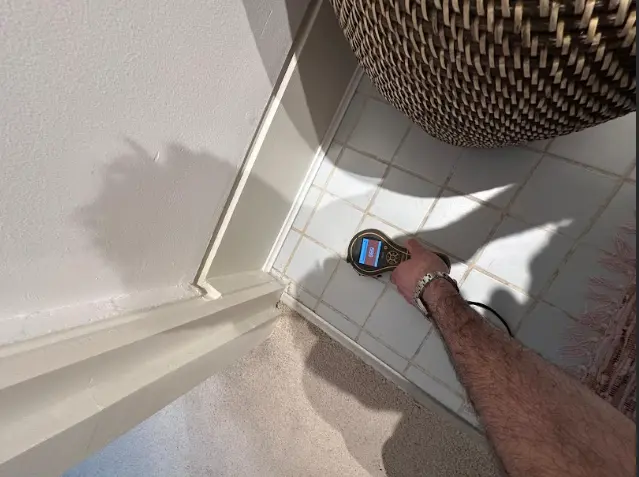
Concrete floors present specific measurement challenges that make standard wall moisture metres unreliable as the primary assessment instrument.
Electrical resistance varies with salt content and aggregate. Pin-type metres measure electrical resistance between two probes. In concrete, the presence of soluble salts — chlorides from de-icing salt, sulphates from ground contamination, carbonation products from the curing process — conduct electricity independently of moisture content. A salt-laden concrete slab can produce elevated pin metre readings even when the slab is genuinely dry, producing false positives that lead to unnecessary remediation.
Aggregate composition affects readings. Some aggregates are more conductive than others. A granite aggregate concrete and a limestone aggregate concrete of identical moisture content can produce different pin metre readings. Without knowing the specific material composition, absolute readings from a pin metre on concrete cannot be reliably compared to published threshold tables.
Moisture migrates more slowly through concrete than most other materials. A concrete slab at depth dries more slowly than the surface. Surface readings — even from a Tramex — can suggest the floor is drying correctly while the core moisture content remains significantly elevated. Completing a drying programme on the basis of surface readings alone, without depth assessment, is one of the most consistent causes of floor covering failure after water damage restoration.
Cold temperature and thermal mass. Ground-bearing concrete slabs in UK properties are in permanent thermal contact with the ground below and typically run at 10 to 15°C year-round — lower in winter. Cold temperatures slow the release of moisture from the slab and can produce consistently elevated surface humidity readings in certain seasonal conditions even in a nominally dry slab.
The Three Measurement Methods and Their Normal Ranges
Method 1 — Pin-Type Resistance Metre (WME Readings)
Pin metres are widely used for wall and floor moisture measurement but are least reliable on concrete floors as an absolute measurement tool. Their most valid use on concrete is comparative — tracking whether readings at the same measurement points are declining over time, rather than assessing absolute moisture content against a threshold.
Typical reading range on a normal, dry concrete floor:
On a dry concrete slab at equilibrium with its environment, pin metre readings (in WME — Wood Moisture Equivalent) typically fall in the range of 4 to 8% WME on most standard UK concrete mixes. However, this range is highly variable depending on:
- Aggregate type and composition
- Salt content of the mix or ground contamination
- Ambient temperature and relative humidity at the time of measurement
- Battery condition of the metre (low battery voltage elevates readings)
A reading of 8 to 12% WME on a concrete floor in an unaffected area of the same property is not unusual and does not indicate a moisture problem. A reading consistently above 15% WME across an affected area, compared to a reading of 6 to 8% on an unaffected section of the same slab, indicates elevated moisture that warrants further investigation.
The key practical rule for pin metres on concrete floors: use them for comparative tracking against a dry standard established on the same slab, not for absolute pass/fail assessment. Never declare a concrete floor at confirmed dry standard based solely on pin metre readings.
Method 2 — Non-Invasive (Tramex) Floor Metre
The Tramex — or equivalent radio-frequency capacitance floor metre — is designed specifically for concrete floor measurement and is more reliable than standard wall pin metres on concrete. It transmits a radio-frequency signal through the floor surface and measures the response, which correlates to moisture content. The Tramex is the standard field instrument for tracking drying progress in concrete floors and screeds during a structural drying programme.
Typical reading range on a normal, dry concrete floor:
A Tramex reading on a dry concrete slab at equilibrium typically falls in the range of 40 to 60 on the Tramex scale (where 0 is bone dry and 100 is fully saturated). The exact reading varies by concrete type, aggregate, and ambient conditions.
Again, the most valuable use of Tramex readings is comparative — establishing a dry standard from readings on an unaffected section of the same slab and tracking readings on the affected section toward that standard over the course of a drying programme.
Tramex readings and the depth limitation: Tramex readings reflect conditions in the upper 20 to 30mm of the slab. A slab with a dry surface but elevated moisture at depth — common in the later stages of a drying programme — can produce acceptable Tramex readings while still failing the definitive depth-measurement test.
Read also- damp in house I just bought what are my options
Method 3 — Relative Humidity Probe (The Professional Standard)
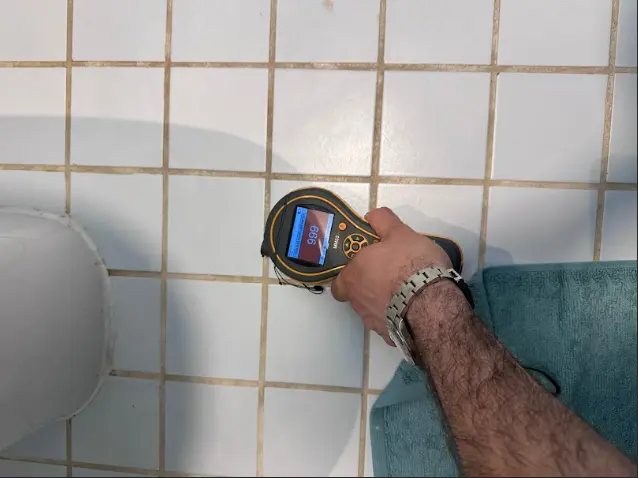
The relative humidity probe test is the definitive method for assessing whether a concrete floor or screed is ready for floor covering installation. This is not a surface reading — it measures the equilibrium relative humidity at depth within the slab or screed.
The method:
- Drill a hole in the slab to approximately 40% of the total screed or slab depth — for a 75mm screed, this is approximately 30mm
- Clean the hole of dust and debris
- Insert a calibrated relative humidity probe and seal the hole opening
- Leave sealed for a minimum of 72 hours — this allows the probe to equilibrate with the moisture conditions at depth within the slab
- Read the equilibrium RH from the probe
What is a normal reading — and what is the pass/fail threshold:
Under BS 8203 (Code of Practice for Installation of Resilient Floor Coverings):
- Below 75% RH: The slab is sufficiently dry for installation of most floor coverings including vinyl, LVT, carpet, and ceramic tiles
- Below 65% RH: Required before installation of moisture-sensitive floor coverings on anhydrite (calcium sulphate) screeds — a stricter threshold that is frequently applied incorrectly when the standard 75% threshold is used for anhydrite
For an unaffected concrete slab in a typical UK property, the equilibrium RH probe reading is typically in the range of 60 to 70% — comfortably within the “dry” range under BS 8203 but not approaching the 40 to 50% reading that would indicate an exceptionally dry slab.
A newly laid concrete slab takes significantly longer to reach the 75% RH threshold. Traditional rule of thumb: one month’s drying time per 25mm of slab depth. A 100mm slab takes approximately four months to cure and dry to a level suitable for most floor coverings under normal conditions.
Why this test matters for water damage restoration:
After a flood or significant water damage event to a concrete floor, the slab and screed must return to below 75% RH (or below 65% RH for anhydrite) before floor coverings can be relaid. A programme that runs industrial desiccant dehumidification to confirmed Tramex readings close to the dry standard but does not perform the 72-hour RH probe test has not completed the professional standard of confirmation. Relaying floor coverings on this basis risks adhesive failure, tile debonding, laminate swelling, and LVT edge lifting within months — typically during a warm spell when the floor warms and releases residual deep moisture.
For BS 8203 code of practice for resilient floor coverings, check: BSI — BS 8203 code of practice
Practical Implications for UK Property Owners
After a water damage event: Do not rely on the floor “looking dry” or on surface Tramex readings alone. Commission a 72-hour RH probe test at 40% of screed depth and confirm below 75% RH before authorising any floor covering installation. This is the standard your insurer’s loss adjuster and any competent contractor will expect.
When buying a property: A property with a ground-bearing concrete floor that has a previous history of flooding or damp — or where the survey has flagged moisture — should have the floor assessed by a BDMA-certified specialist using Tramex monitoring and, where the drying history is uncertain, a 72-hour RH probe test. Surface readings that appear acceptable can mask residual deep moisture that will cause floor covering failure after purchase.
For new build snagging: Newly laid concrete floors in new-build properties require the full curing and drying period before floor coverings are installed. Developers sometimes install floor coverings before the slab has reached the BS 8203 threshold, producing floor covering failures within the first two years of occupation. A snagging inspection that includes a 72-hour RH probe test gives new build owners documented evidence of the floor’s moisture condition at the time of handover.
Disaster Care Capital provides BDMA-certified moisture assessments for concrete floors across London — including Tramex monitoring, 72-hour RH probe testing to BS 8203 standards, and full documentation for insurance claims and reinstatement authorisation. Call us today for a free same-day consultation.
For IICRC structural drying standards and concrete floor assessment guidance, check: IICRC — S500 water damage restoration standard
Conclusion
A normal moisture reading for a concrete floor in the UK depends entirely on the instrument used. Pin metres on concrete give comparative rather than absolute readings — dry standard typically 4 to 8% WME on an unaffected section of the same slab. Tramex floor metres give comparative readings against the same slab’s dry standard rather than an absolute threshold. The definitive professional standard is the 72-hour relative humidity probe test at 40% of slab depth — below 75% RH for most floor coverings, below 65% RH for anhydrite screed, under BS 8203. Surface readings that appear acceptable can mask elevated moisture at depth that causes floor covering failure after installation.
Frequently Asked Questions
What is a normal moisture reading for a concrete floor in the UK?
For pin metres, a normal reading on an unaffected dry concrete slab is typically 4 to 8% WME — but this varies by aggregate type and salt content, making the reading comparative rather than absolute. For the definitive BS 8203 standard, a 72-hour relative humidity probe at 40% of slab depth should read below 75% RH for most floor coverings and below 65% RH for anhydrite screed.
Can I use a standard wall moisture metre on a concrete floor?
Pin-type resistance metres give unreliable absolute readings on concrete because salt content and aggregate composition affect electrical resistance independently of moisture. They are useful for comparative tracking — monitoring whether readings at fixed points are declining toward a dry standard established on an unaffected section of the same slab. For a definitive pass/fail assessment before relaying floor coverings, a calibrated Tramex and a 72-hour RH probe are required.
How long does it take for a concrete floor to dry to a safe moisture level?
After a water damage event with industrial desiccant drying equipment deployed promptly and floor coverings removed, sand and cement screed typically takes 4 to 8 weeks to reach below 75% RH. A newly laid concrete slab without active drying takes approximately one month per 25mm of depth under normal conditions. Anhydrite screed takes longer and requires the stricter 65% RH threshold.
What moisture level is acceptable in a concrete floor before laying floor tiles?
The 72-hour RH probe reading must be below 75% relative humidity at 40% of slab depth for most floor coverings including ceramic tiles, LVT, vinyl, and carpet. For anhydrite (calcium sulphate) screeds, the threshold is below 65% RH. These are the BS 8203 standards — not optional industry guidelines but the professional and legal standard for floor covering installation.





