


Cast your eyes over the buildings on any busy UK high street, office district, or industrial estate. Some look crisp, clean, and professionally presented. Others are streaked with dark pollution stains, patchy with green algae, or dulled by years of accumulated grime. Now ask yourself honestly: which of those buildings would you rather do business with?
Your building’s facade is its first impression. Before a client steps through your door, before a tenant signs a lease, before a customer decides whether to trust your brand, they have already made a judgement about you based on what they see from the pavement. And yet, facade cleaning services remain one of the most overlooked aspects of building maintenance in the UK.
At Disaster Care Capital, we work with building owners, facilities managers, and property professionals across the country who have discovered that neglecting the exterior of their buildings is never truly a saving. In this guide, we explain what professional facade cleaning services involve, why they matter far more than most people realise, and how getting it right can protect both your property and reputation for years to come.
What Are Facade Cleaning Services?
Put simply, facade cleaning services involve the professional cleaning of a building’s exterior surfaces: removing the accumulated dirt, pollutants, biological growth, staining, and weathering that builds up on every building over time, regardless of how well it was originally constructed.
The term “facade” refers to the outermost face of a building: the walls, cladding, stonework, brickwork, render, glass, metal panels, and any other external surface that is exposed to the elements. Each of these materials presents its own cleaning challenges, and each requires a different approach to ensure it is cleaned effectively without causing damage.
Professional facade cleaning can be carried out across a wide range of materials, including brick, concrete, cladding, delicate stonework, and glass, with specialist methods available even for listed and heritage buildings, where protecting sensitive surfaces is paramount.
What that means in practice is that there is no such thing as a one-size-fits-all facade clean. The right service should always begin with a proper assessment of your building, its materials, and the specific nature of the soiling before a single piece of equipment is deployed.
What Makes a Building Facade Dirty?
This is a question many building owners have never stopped to consider — and the answer is rather more complex than simply “the weather.”
In urban environments, the primary culprit is airborne pollution. Car exhausts contribute significantly to facade discolouration in urban settings, with soot particles adhering to surfaces and causing a progressive darkening effect over time. If your building sits near a main road, a railway, or any kind of industrial activity, this process is accelerated considerably.
In areas with shaded elevations, particularly north-facing walls or sections of a building overshadowed by trees or adjacent structures, biological growth is the predominant issue. Mould, mildew, lichen, and algae thrive in damp, low-sunlight conditions, and these organic substances not only mar the aesthetic appeal of a building but can also pose potential health risks if left untreated.
Metal elements within or adjacent to a facade present yet another problem: rust. Over time, iron fixings, window frames, and structural components oxidise and leave unsightly orange streaks that are notoriously difficult to remove without the right treatment.
Then there is the cumulative effect of weather itself, which gradually breaks down surface coatings, opens up micro-cracks in render and stonework, and creates the conditions for moisture ingress. Once moisture penetrates a facade, the problems escalate quickly.
Over time, weather, pollution, and wear and tear can weaken the facade, causing cracks, leaks, and even collapse in extreme cases, issues that not only compromise the structural safety of the building, but also pose real risks to its occupants and passers-by.
The Hidden Cost of a Dirty Building
Here is where many building owners and facilities managers get caught out. Facade cleaning services are sometimes perceived as a cosmetic luxury — something to schedule when budgets allow, not an operational priority. This perception can be an expensive one.
Consider a real-world scenario that we encounter regularly: a commercial office building in a city centre that has not had its stonework cleaned in six or seven years. By the time the owner finally commissions a survey, the build-up of biological growth has begun trapping moisture against the stone. That moisture has opened up hairline fractures in the pointing. Water has penetrated behind the cladding at one elevation. What began as a routine facade cleaning job has become a facade cleaning and remediation project, with associated costs many times higher than a proactive maintenance programme would ever have reached.
Delaying the repair of moisture penetration increases the risk of concrete degradation, rust on rebar, and wall damage, resulting in progressively higher repair costs. The longer facade maintenance is deferred, the steeper the eventual bill.
There is also a commercial dimension to this that goes beyond bricks and mortar. Neglected facades with cracks, stains, or visible damage give off an impression of neglect and disrepair — diminishing property value and making it harder to attract and retain tenants. A well-maintained facade, conversely, enhances kerb appeal and actively supports property value.
For more information on the relationship between building maintenance standards and property value, check: Designing Buildings — Facade Cleaning Wiki
Professional Facade Cleaning Methods Explained
One of the things that sets a professional facade cleaning service apart from a pressure washer hired for the weekend is the range and precision of methods available. At Disaster Care Capital, we select and combine cleaning techniques based on what each specific building, surface, and soiling type requires — never applying a one-size approach to what is always a bespoke challenge.
Pressure Washing and Jet Washing
Jet washing is ideal for removing stubborn dirt from durable surfaces such as concrete, brick, and hard stone. The pressure is carefully calibrated to the surface in question — too low and the cleaning is ineffective; too high and surface damage, erosion of pointing, or drive-in of water behind the facade can result. This distinction is why professional calibration matters enormously.
Steam Cleaning
For more delicate exterior surfaces — natural stone facades, render, painted masonry, and heritage stonework — steam cleaning is a far gentler but equally effective alternative. Steam cleaning is a gentle, eco-friendly method particularly well-suited to delicate exteriors, removing biological growth, grease, and ingrained grime without the aggressive force of high-pressure water.
Soft Washing
Soft washing combines low-pressure water delivery with specialist biodegradable chemical treatments that break down algae, mould, lichen, and organic staining at the source rather than simply blasting it away. This method is particularly effective for render, timber cladding, and painted surfaces where pressure washing would cause irreparable damage.
Reach and Wash Systems
Water-fed pole systems use extendable poles with brushes at the end, through which purified water is pumped — ensuring a streak-free finish and effectively removing dirt, grime, and pollutants from the facade without the need for scaffolding or elevated platforms in many cases. This makes them especially practical for mid-rise commercial buildings and glass facades.
Rope Access and Abseiling
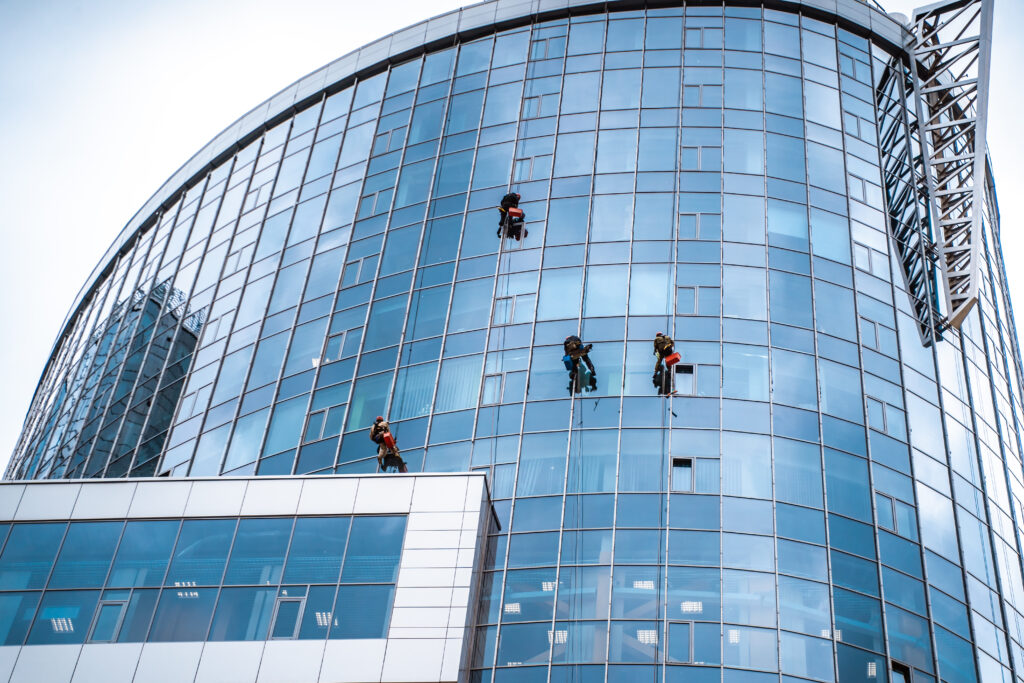
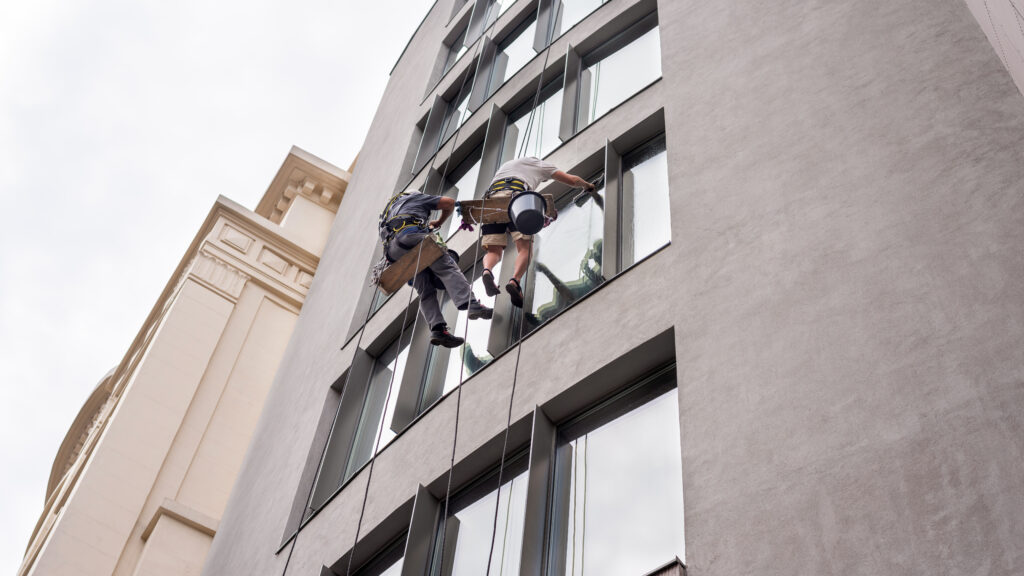
For high-rise buildings, complex architectural features, or elevations where platform access is not practical, rope access — using IRATA-trained operatives — is arguably the most cost-effective and safest technique available, allowing teams to move laterally as well as vertically to reach all areas of a building’s facade.
Chemical and Biocide Treatments
Where biological growth — algae, lichen, moss, and mould — is the primary issue, biocide treatments applied after cleaning provide lasting protection by inhibiting regrowth. These treatments are carefully selected to be effective whilst meeting current environmental regulations.
For a detailed overview of professional facade access and cleaning standards in the UK, check: Health & Safety Executive — Working at Height Guidance
Facade Cleaning for Different Building Types
Not all buildings are equal, and facade cleaning services must be tailored accordingly.
Commercial and Office Buildings — Businesses depend on their premises making the right impression. Regular facade cleaning on a scheduled contract basis ensures that your building always presents professionally to clients, suppliers, and the public, without the disruption of a large-scale remediation project becoming necessary.
Retail Properties — Footfall is everything in retail. A clean, well-presented exterior draws customers in. An algae-streaked, pollution-stained shopfront communicates the opposite of the confidence and quality your brand works hard to project.
Industrial and Warehousing Properties — Even industrial buildings benefit from regular facade maintenance. Beyond aesthetics, the accumulation of chemical residues, oil deposits, and biological growth on industrial cladding can accelerate material degradation significantly.
Listed and Heritage Buildings — These require the most specialist approach of all. Cleaning stone facades can require special knowledge, since incorrect methods can cause irreparable damage — and ideally, stone facades should be addressed before dirt builds up rather than after, to minimise the risk of surface harm. Our teams are experienced in working with conservation officers and heritage contractors on sensitive historic properties.
Residential Blocks and Apartment Buildings — Managing agents and freeholders have a duty of care to maintain the fabric of a building. Regular facade cleaning keeps residents satisfied, protects the value of individual units, and demonstrates professional management standards.
How Often Should You Schedule Facade Cleaning Services?
The frequency of facade cleaning depends on factors such as location, exposure to pollution, and weather conditions. Urban environments and areas with high traffic typically require cleaning every six to twelve months, as regular maintenance prevents the long-term damage caused by dirt, grime, and algae build-up.
Buildings in more rural or suburban settings with lower pollution exposure may be adequately served by a thorough clean every two to three years. Heritage stone buildings may require more conservative, more frequent attention to keep surfaces in good condition without the need for interventionist remediation.
The most sensible approach is to establish a maintenance schedule based on a proper assessment of your building — one that accounts for orientation, local environment, and the specific materials involved. A professional facade cleaning company should be able to advise you on a programme that protects your building cost-effectively over the long term.
Why Choose Disaster Care Capital for Facade Cleaning Services?
At Disaster Care Capital, our facade cleaning teams bring the same rigorous, professional approach to every project — whether it is a single commercial property or a multi-site portfolio. We assess before we act, we select the right methods for each surface and situation, and we work to the highest standards of health and safety, using only accredited, trained operatives.
We understand that scheduling facade cleaning services often means working around occupied buildings, open businesses, and public pedestrian areas. Our teams are experienced in planning and executing work with minimal disruption — including out-of-hours, evening, and weekend operations where needed.
And because we provide full documentation of every clean — including condition records, methods used, and recommendations for ongoing maintenance — you have complete confidence that your building is being cared for properly, and a clear paper trail to support insurance and asset management requirements.
Your building is one of your most significant assets. Let Disaster Care Capital make sure it looks the part.
Frequently Asked Questions About Facade Cleaning Services
Q1: Can facade cleaning services damage my building’s exterior?
When carried out correctly by trained professionals using the appropriate methods for your specific surface materials, professional facade cleaning will not damage your building. The risk of damage arises when incorrect methods are used — for instance, applying high-pressure jet washing to a delicate stone or render facade. This is precisely why a thorough initial assessment of your building’s materials and condition is a non-negotiable first step. At Disaster Care Capital, we never begin a facade cleaning project without a proper site assessment.
Q2: Do I need scaffolding for professional facade cleaning?
Not necessarily. Modern facade cleaning methods — including rope access, reach and wash pole systems, mobile elevated work platforms (MEWPs), and water-fed systems — mean that a great many facade cleaning projects can be completed without traditional scaffolding. This significantly reduces both cost and disruption. The appropriate access method will depend on the height and complexity of your building, and our team will advise you on the most practical and cost-effective approach after assessing your property.
Q3: Is facade cleaning covered under a standard building maintenance contract? This depends on the terms of your specific contract. Many facilities management agreements include periodic exterior cleaning as part of a broader planned preventative maintenance (PPM) programme, but the frequency and scope can vary considerably. We strongly recommend reviewing your existing maintenance contract to confirm what is covered, and speaking to us about a tailored facade cleaning service agreement that complements your current arrangements and protects your building on an appropriate schedule.





