


If you have cleaned the same condensation mould keep coming back patch two, three, or four times and it keeps returning in exactly the same spot, you are not doing it wrong. You are solving the wrong problem.
Surface cleaning with bleach, antifungal spray, or any over-the-counter mould remover will successfully remove what is visible on the wall. It does not remove what is causing the mould to grow there in the first place. And because the cause has not been addressed, the mould comes back. Every time. Often faster and more extensively than before, because repeated surface treatment can damage the plaster surface and create even more suitable conditions for fungal colonisation.
The frustration you feel is completely justified. The solution is not to clean more thoroughly or use stronger products. The solution is to understand what is actually happening inside the wall and beneath the surface and to address that instead.
1. Why Cleaning Mould With Bleach Doesn’t Work Long-Term
Bleach is the first thing most people reach for when they see black mould on a wall. It is cheap, widely available, and it appears to work — the mould goes white, then seems to disappear. But within weeks or months, the same patch is back.
The reason bleach fails is structural. Household bleach is primarily water — approximately 95% water with around 5% sodium hypochlorite. When you apply it to a porous surface like plaster or plasterboard, the water component soaks into the surface. The sodium hypochlorite remains on the top layer and does not penetrate.
Mould is not primarily a surface phenomenon. The visible black or green growth on your wall is the fruiting body — the external manifestation of a fungal colony whose root-like structures (called hyphae) have penetrated into the substrate material. Bleach decolorises and kills what is on the surface. It leaves the hyphae inside the wall intact. Given any moisture, those hyphae produce new surface growth within days to weeks.
Antifungal paints and surface sprays have a similar limitation. They create a hostile surface environment for new growth, but they cannot reach the organisms already established within the plaster, plasterboard, or masonry. Applied over an active mould colony in a substrate, they typically delay regrowth rather than preventing it.
Read also- Renter’s Rights Act 2026 and mould in the UK: What it means for tenants and landlords
2. The Real Cause: Moisture in the Substrate, Not the Surface

Mould does not grow on a wall because the surface is dirty. It grows because the surface — or the material behind it — contains enough moisture to sustain fungal life. The visible mould patch is telling you one thing and one thing only: this part of your wall is consistently wet enough to support mould growth.
That moisture can come from several sources:
- Condensation on cold surfaces — warm, humid air from cooking, bathing, breathing, and drying clothes meets cold wall surfaces (particularly external walls, north-facing walls, and cold bridge areas) and deposits moisture. In UK winters, with heating cycling on and off and windows kept closed, this condensation is cumulative.
- Moisture already within the substrate — plaster and plasterboard are absorbent materials. Once they have absorbed moisture through repeated condensation, the moisture content within the material creates the conditions for growth even if the surface looks dry.
- Structural damp — rising damp or penetrating damp from a roof, wall, or plumbing defect may be feeding moisture into the wall from behind, creating a permanent wet zone that surface treatment cannot address and ventilation alone cannot dry.
The critical point: if the moisture source is not identified and eliminated, no amount of surface treatment will produce a lasting result. The mould will return to the same spot because the same conditions will exist in the same spot, indefinitely.
3. How Mould Spores Work — and Why They Survive Surface Cleaning
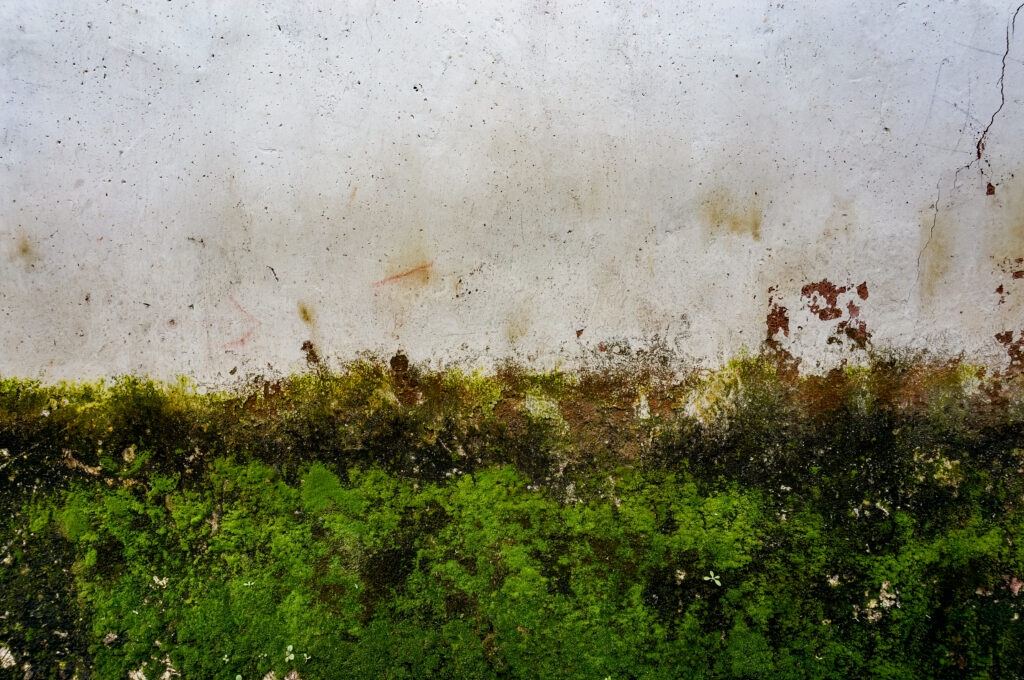
Understanding mould biology explains why recurring mould is so persistent and why the approach most people take is inadequate.
Mould reproduces by releasing microscopic spores into the air. These spores are present in virtually every indoor environment — they are part of the normal atmospheric environment of any building. Under dry conditions with low humidity, they remain dormant. The moment moisture conditions become favourable — relative humidity on a surface consistently above 70–80%, or material moisture content at mould-permissive levels — dormant spores germinate within 24 to 48 hours.
When you clean mould from a wall surface, you remove the visible colony. But:
- Spores embedded within the plaster or plasterboard are not reached by surface cleaning and remain viable for months to years
- Hyphae extending into the substrate remain structurally intact
- New spores from atmospheric deposition will land on the same surface within hours
- If the moisture conditions that caused the original growth still exist, recolonisation from either source is essentially guaranteed
This is why the same patch returns in the same spot. The surface has been cleaned. The conditions within and behind the wall have not changed. The spores are still there, or new ones land and germinate immediately, because the conditions are ideal.
4. The Link Between Ventilation, Heating and Mould Recurrence
The environmental conditions that produce condensation mould are well understood. They are also genuinely difficult to manage in many UK homes — particularly in flats, older properties, and properties that are either under-heated or have inadequate ventilation.
What creates condensation mould conditions:
- Inadequate ventilation — without sufficient air movement, humid air generated by occupants accumulates in the property. Kitchens and bathrooms produce large volumes of moisture; without extractor fans running effectively, that moisture distributes throughout the property and deposits on cold surfaces.
- Insufficient heating — cold wall surfaces drop below the dew point of the room air and cause condensation. Properties where heating is run intermittently, kept very low, or left cold overnight are particularly prone. Cold rooms that are used infrequently — spare bedrooms, studies, hallways — are common mould locations precisely because surface temperatures in them drop lower than in occupied, heated rooms.
- Cold bridges — structural elements where heat loss creates locally colder surfaces: window reveals, wall-ceiling junctions, corners of rooms, areas where insulation is absent or insufficient. Mould appearing specifically in corners and around windows is almost always condensation driven by a cold bridge.
- High occupancy or lifestyle moisture — a property with multiple occupants drying clothes indoors, cooking without extraction, or bathing frequently generates significantly more indoor moisture than a single-occupant home. The building’s ability to manage that moisture depends on its ventilation and heating.
Improving ventilation, increasing heating in cold rooms, sealing or insulating cold bridges, and reducing indoor moisture generation all reduce condensation risk. But they address the environmental conditions — not the mould that is already established in the substrate. Both elements need to be addressed.
Read also- How does a dehumidifier work for damp
5. When Is Condensation Mould a Structural Problem?
Not all recurring mould is purely a condensation management problem. In many cases, particularly in older properties, poorly insulated buildings, or properties with historic maintenance issues, the moisture driving the mould is structural in origin.
Signs that recurring mould may have a structural cause:
- The mould appears on a wall that does not face a bathroom or kitchen and is not a corner or cold bridge area — suggesting an external moisture source rather than condensation
- Damp patches persist or appear worse in wet weather — indicating penetrating damp from a failed roof, guttering, pointing, or render
- The mould is concentrated at low level near the base of walls, with a visible tide mark or salt deposits — indicators of rising damp
- The moisture content of the wall, measured by a calibrated moisture metre, is significantly elevated even in summer when condensation conditions are absent
- The mould keeps returning despite genuine improvements to ventilation and heating — suggesting the moisture source is not atmospheric
In any of these scenarios, surface mould treatment is addressing a symptom of a structural problem that will not resolve until the building defect is repaired. A professional moisture assessment using thermal imaging and calibrated moisture metres is the only way to establish whether the cause is condensation or structural with confidence.
6. What Professional Mould Remediation Actually Involves
Professional mould remediation is not the same as cleaning. It is a systematic process that addresses the mould at every level — on the surface, within the substrate, and at the moisture source. This is what distinguishes a professional treatment that lasts from a surface clean that fails within weeks.
A professional mould remediation programme involves:
Moisture assessment first. Before any treatment begins, calibrated moisture metres and thermal imaging cameras establish the moisture content within the affected materials and identify whether the source is condensation, structural damp, or plumbing. Treatment applied without this assessment is guesswork.
HEPA vacuuming. High-efficiency particulate air (HEPA) vacuuming removes the surface mould colony and, critically, captures the spores that surface cleaning would otherwise disperse into the room air. Bleach and spray products disturb spores and spread them; HEPA vacuuming removes them from the environment entirely.
Controlled demolition where necessary. Where mould has penetrated deeply into plasterboard or timber, or where the substrate is damaged beyond effective treatment, the affected material is removed. Treating mould within damaged plasterboard is ineffective; removal and replacement on a properly dried substrate is the correct approach.
Structural drying of affected materials. Where moisture content within building fabric is elevated, active drying using industrial dehumidifiers and air movers is required before any surface treatment will hold. Applying biocide to a wet substrate is as futile as painting a wet wall.
Application of professional-grade biocidal treatment. Professional biocidal products are applied to dry surfaces at the correct concentration and penetration depth. Unlike consumer sprays, these products are formulated to reach into porous building materials and treat established hyphae within the substrate, not just surface contamination.
Protective coating application. A mould-inhibiting protective coating is applied as the final layer. This is not mould-resistant paint applied over the problem, it is a post-remediation barrier applied to a clean, dry, treated substrate.
Addressing the moisture source. Structural repairs, ventilation improvements, and cold bridge insulation are recommended or carried out depending on the source identified in the initial assessment. This is the step that makes the treatment permanent rather than repeated.
Disaster Care Capital doesn’t just clean mould — we treat the substrate, eliminate spores, address the moisture source, and apply a protective coating. Call us today for a free assessment that includes a written guarantee.
For further reading on health effects of mould exposure, check: GOV.UK — damp and mould health risks
7. How to Stop Mould Returning Permanently
The permanent resolution to condensation mould requires three things to be addressed simultaneously. Achieving any one of them without the others will reduce but not eliminate the problem.
Treat the mould that already exists — properly. Professional remediation to the standard described above removes the established colony from the substrate, eliminates spores, and prepares the surface for lasting treatment. This is the foundation. Without it, even perfect ventilation and heating will not prevent new growth from the existing colony.
Eliminate or reduce the moisture source. For condensation-driven mould:
- Run extractor fans during and for at least 15 minutes after cooking or bathing
- Maintain background heating in all rooms throughout winter — even unused rooms
- Dry clothes outside or in a well-ventilated space; a single load dried indoors produces over 2 litres of water vapour
- Open windows briefly even in winter — 10–15 minutes of cross-ventilation creates meaningful air exchange
- Insulate cold bridges where accessible and practical — particularly window reveals and room corners
For structurally-driven mould, the repair of the defect causing the moisture ingress is the irreplaceable step.
Improve the building’s ability to manage moisture. Mechanical ventilation with heat recovery (MVHR) or positive input ventilation (PIV) systems provide continuous controlled air exchange that passive ventilation cannot reliably achieve. In chronically affected properties these systems can be transformative.
For guidance on identifying the type of damp affecting your property, check: Shelter England — damp and mould in rented homes
Conclusion
Condensation mould keeps coming back because surface cleaning addresses the symptom while the cause — moisture within the substrate and a continuing source of that moisture — remains intact. The mould is not returning because you cleaned it incorrectly. It is returning because what needs treating is inside the wall and beneath the surface, not on it.
Professional remediation treats the mould at depth, removes spores from the environment, dries the substrate, and addresses the moisture source. Combined with practical ventilation and heating improvements, and structural repairs where the cause is not condensation, it produces a permanent result rather than a temporary one.
Disaster Care Capital treats the cause, not the surface. If the same mould patch keeps returning, call us today.
Frequently Asked Questions
Is bleach effective for removing mould?
Bleach removes surface mould visually but does not penetrate porous building materials where the fungal colony is established. The sodium hypochlorite in bleach stays at the surface while the hyphae within the substrate survive, which is why mould treated with bleach typically returns within weeks to months.
Can mould grow inside walls?
Yes — mould readily colonises the interior of plasterboard, the surface of timber studs, and within masonry where moisture conditions are favourable. Interior mould growth is often invisible from the room but produces spores that pass through any surface imperfections and, in severe cases, contributes to structural material degradation.
How do I get rid of mould permanently?
Permanent mould removal requires three elements addressed simultaneously: professional treatment of the existing colony at substrate level (not surface cleaning); elimination or significant reduction of the moisture source; and improvement of the building’s ventilation and thermal performance to prevent recurrence. Addressing any one element without the others reduces but does not eliminate the problem.





